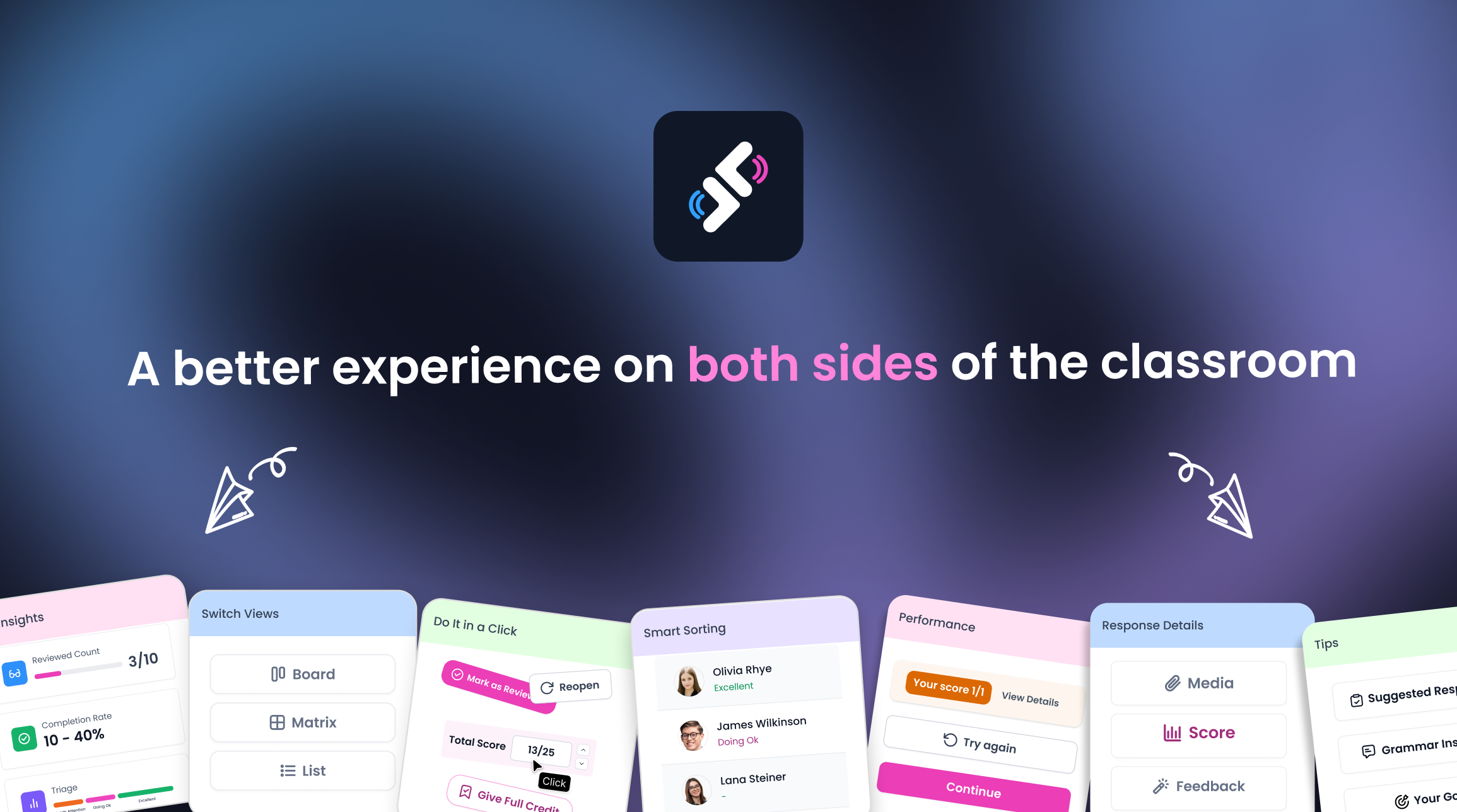
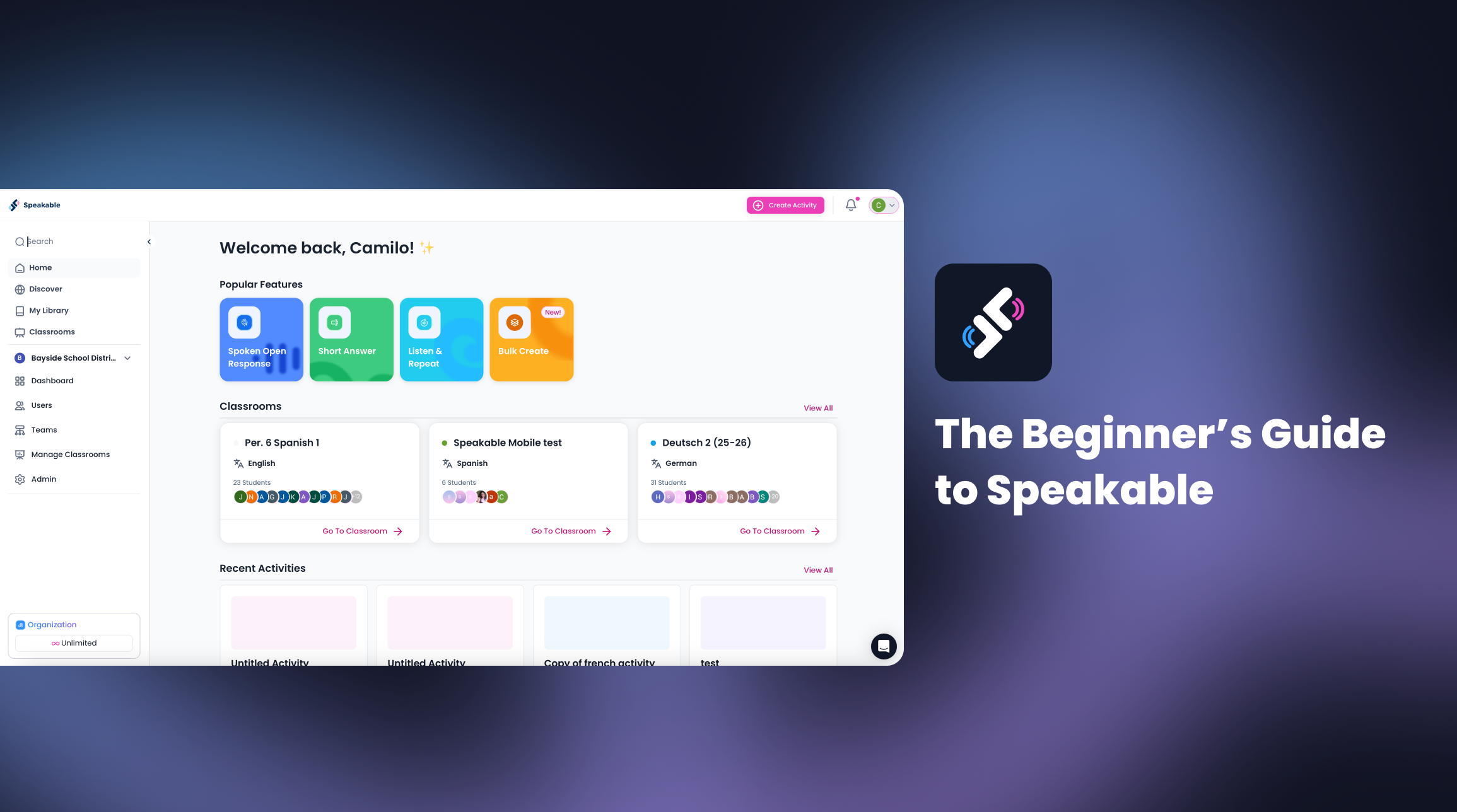
This update reorganizes Speakable around the way many teachers already move through their work: create an activity, assign it, and review student responses.
Benchmarks show where students stand, using your preferred standards framework as a reference. Get a clear snapshot across classes and track progress over the school year.
Instant feedback helps students improve as they practice. Auto-grading saves teachers hours, so authentic speaking, listening, reading, and writing can happen more often.
Rubric-based auto-grading makes it easier to assess speaking and writing. Review quickly with AI summaries, adjust scores, and release results when ready.
For many schools and districts, ACCESS testing and the Seal of Biliteracy represent key milestones in language education.
They also raise important questions for leaders:
Are students truly prepared to demonstrate their language skills?
Across districts and schools, programs that consistently support student speaking growth tend to share a few core foundations. Not trends. Not buzzwords. Real, repeatable decisions that show up every day in classrooms. Here’s what they have in common.
January speaking activities need to feel different. This isn't the time for high-stakes performance or heavy correction. Right now, you're rebuilding comfort and trust.
Here are activities that work in those first weeks back because they're low-pressure and just creative enough to get students actually talking.
AI is no longer something “extra” in the classroom.
In 2026, it’ll become the quiet assistant that helps teachers plan faster, reduce workload, and give students more meaningful attention.
Most leaders agree on one thing.
Speaking is the skill that reflects true proficiency. It shows what students can actually do with the language. Families ask about it, accountability systems point to it, and programs depend on it.
December has a rhythm of its own.
Shorter weeks, unpredictable schedules, concerts, exams, early dismissals, field trips, half-focused classrooms… and teachers doing their best to hold everything together.
The last weeks of the year don’t need more pressure. This end-of-year teaching checklist helps language teachers close the semester with clarity, calm, and continuity.
Great speaking practice starts with great questions. Here’s how to craft prompts that make students think, speak, and connect; plus examples you can use this week.
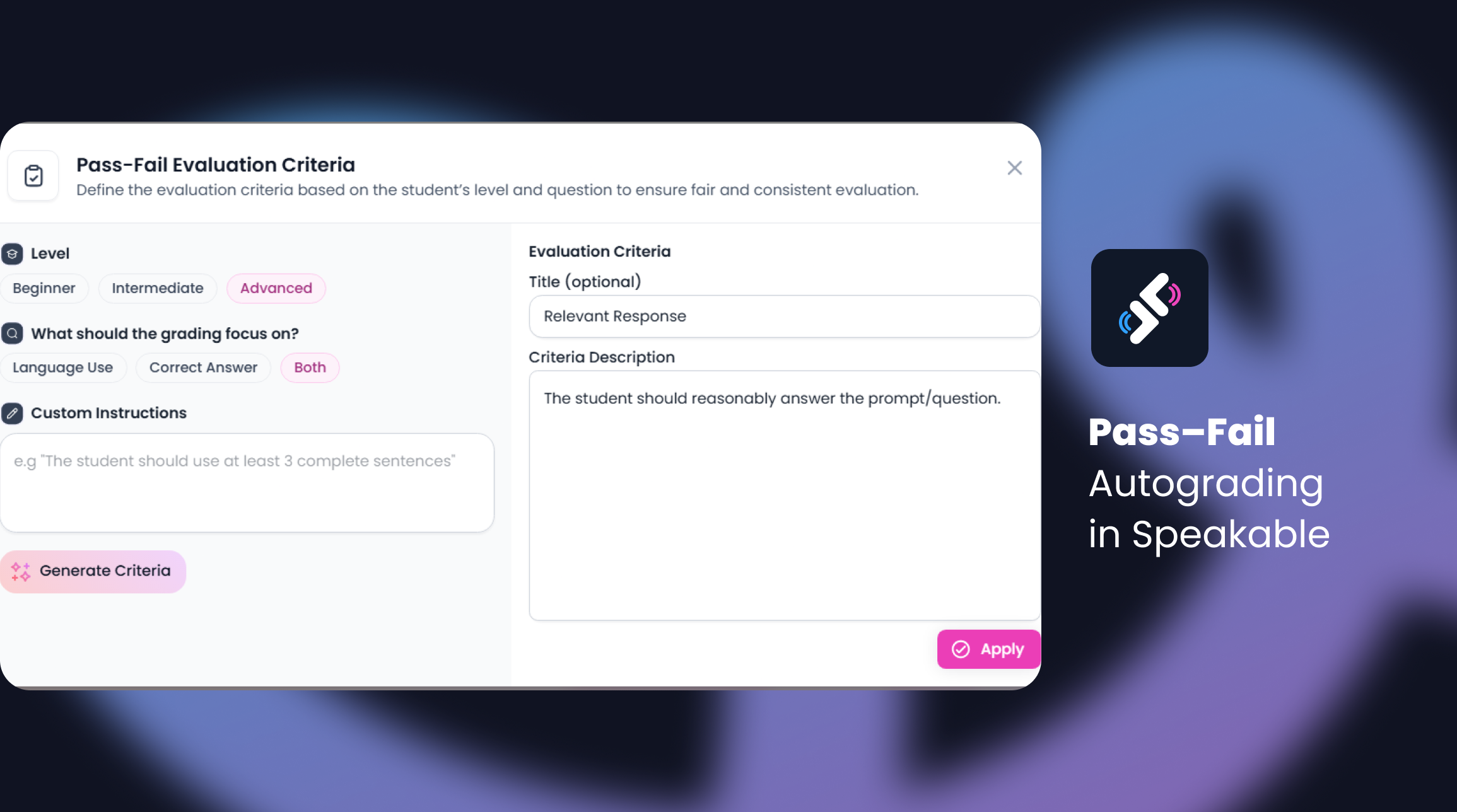
When students submit a spoken or written open response in Speakable, pass–fail autograding helps you check work quickly and consistently. It shows whether a student met the expectations you set and returns short, clear feedback right away.
Picture this: You've just assigned a speaking activity to your class of 30 students. The next day, you log in to review their work. Where do you start? Who needs help first? Who's ready to move on? For most teachers, answering these questions meant listening to dozens of recordings, one by one, taking notes, and mentally triaging students.
Accent anxiety keeps many students from speaking up, even when they know the right answer. This post explores how teachers can turn that fear into growth by reframing pronunciation feedback as guidance, helping students speak with clarity, confidence, and pride in their voice.
You finish grading a pile of speaking recordings late at night. By the time you return the feedback, it is Wednesday. Students have already moved on to a new topic. The moment of reflection, that instant when their voice was still in their head, is gone.
As schools plan for the next academic cycle, one thing is clear: performance matters more than paperwork. Proficiency isn’t being defined by tests alone anymore. It’s about consistent, authentic communication that reflects real-world ability.
AI used to be the assistant, the silent helper in the background, grading, organizing, automating. But 2025 is showing us something different: a new kind of relationship between teachers and technology. One that feels more like a partnership than support.
Introducing AI into a school community always raises questions. Parents want to understand how technology will affect their children’s learning, privacy, and relationships with teachers.
In conversations about education technology, one concern consistently arises: Will AI replace teachers? It is an understandable worry. Teachers shape not only what students learn, but also how they feel about the learning process.
Strong relationships are the foundation of every successful classroom. For language teachers, that connection goes beyond classroom management. It directly shapes how willing students are to speak up, make mistakes, and keep trying.
Every school leader knows the challenge: great language teachers are hard to find, and even harder to keep. The departments that thrive aren’t just about curriculum or test scores; they’re places where teachers feel supported, valued, and excited to teach.
You know that pile of speaking assessments you’ve been meaning to grade? The one that’s been staring at you all week? What if you could get through it in 30 minutes instead of three hours, while still giving feedback your students can actually use?
For many school and district leaders, strategic planning is more complex than ever. And while AI used to be a future consideration, it’s now an essential tool at the planning table.
That Pinterest-perfect classroom routine you mapped out in August? Color-coded stations, detailed morning procedures, flawless transitions? By mid-September, it may already feel like a heavy lift.
Educators have always known that assessment is more than just assigning a grade; it’s about understanding student progress and helping them grow. But as classrooms become more diverse and demands on teachers increase, many schools are questioning whether traditional assessment methods can still keep up.
Your school culture speaks, even when you’re not in the room.The hallway posters, the way conflicts are resolved, whose voices are heard in class, everything tells a story.The real question is: what story is your school telling?
The first weeks of school set the tone for your entire year. A calmer classroom isn't just nicer, it's essential for your well-being as a teacher.When your classroom runs smoothly, you spend less energy managing chaos and more time actually teaching.
With more classrooms adopting AI tools like Speakable, understanding how to apply its grading options effectively can help you give students meaningful feedback without adding to your workload. Each method is designed for different types of language tasks. Here's a simple guide to help you choose the best one for your lesson
55% of teachers plan to quit earlier than initially intended, and 23% left their school between October 2022 and October 2023.
But here's what matters: job satisfaction influences retention more than salary alone.
These 10 prompts are your secret weapon. They work across languages, levels, and age groups, and they're designed to get students talking naturally instead of reciting memorized phrases like robots.
AI isn't just for tech experts anymore. It's becoming the teaching assistant you never knew you needed. Here are six ways it's already changing classrooms like yours.
The school year is full of moving parts, lesson planning, grading, meetings, parent communication, and the endless to-do list can make it feel like there’s never enough time. But what if you could get better results without working more hours?
.svg)


.png)
.png)






.png)









.png)







.jpeg)






.png)